Combating Automated Play in Digital Poker: Detection Methods and Platform Responses
Written by Amir Albrecht · Oct 4, 2026

Combating Automated Play in Digital Poker: Detection Methods and Platform Responses
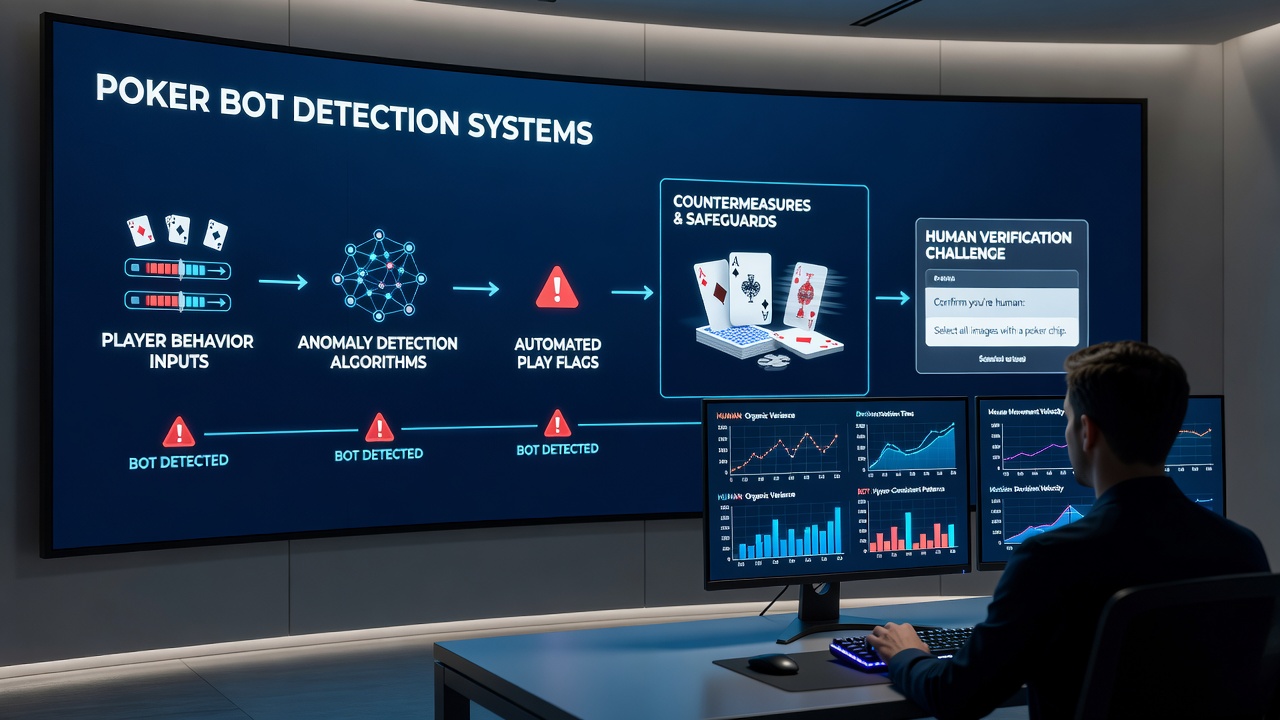
Online poker platforms have developed multiple layers of protection against automated programs that attempt to replace human decision making at virtual tables, and these systems combine statistical monitoring with behavioral analysis to flag suspicious activity before it disrupts game balance.
Operators track decision timing patterns because bots often execute moves at consistent intervals that deviate from human variability, while sudden shifts in aggression levels or hand selection frequencies trigger alerts when they exceed established baselines for individual accounts.
Core Detection Mechanisms
Behavioral profiling forms the foundation of most current systems since platforms record thousands of actions per player across sessions to build individual models, and deviations from these profiles such as unnaturally precise bet sizing or repetitive response sequences prompt deeper investigation by automated tools and human review teams.
Mouse movement tracking and click pattern analysis add another dimension because genuine players exhibit natural hesitations and irregular cursor paths, whereas scripted software produces mechanical trajectories that algorithms can isolate with increasing accuracy.
Network and device fingerprinting helps identify coordinated bot farms by linking multiple accounts through shared hardware signatures or IP clusters, and this approach has proven effective when operators cross reference data across different rooms during joint industry efforts.
Advanced Technology Integration
Machine learning models now process real time data streams to distinguish between skilled human play and automated scripts, and these systems improve through continuous training on labeled datasets of confirmed bot activity versus legitimate sessions.
Platforms also monitor for software signatures by scanning for known bot program indicators during client interactions, while encrypted communication channels and regular updates to detection protocols limit the window in which new scripts can operate undetected.
Collaboration between major operators and specialized security firms has accelerated since early 2026, and shared databases allow faster identification of emerging bot variants that migrate across different poker networks.
Regulatory bodies in several jurisdictions require documented anti bot measures as part of licensing conditions, which has encouraged investment in detection infrastructure without prescribing specific technical solutions.
Countermeasures and Player Protections
When suspicious patterns reach threshold levels, platforms apply graduated responses that range from temporary session restrictions to full account closures, and these actions often include seizure of funds associated with automated play according to terms of service agreements.
Players receive notifications when their accounts undergo review, though operators withhold detailed detection criteria to prevent circumvention attempts, and appeal processes exist for cases where legitimate high volume play triggers false positives.
Education initiatives from industry groups inform participants about acceptable play patterns, and some rooms publish general guidelines on decision speed and multi tabbing limits that reduce accidental violations while maintaining focus on intentional automation.
Recent Developments in October 2026
October 2026 saw several North American platforms deploy updated detection modules that incorporate graph based analysis of player networks, and these tools map relationships between accounts to uncover larger bot operations more efficiently than previous isolated checks allowed.
Research from academic institutions has contributed public findings on statistical markers of automated play, and operators have incorporated select elements from these studies into proprietary systems while maintaining competitive separation in their full methodologies.
Conclusion
Effective bot detection requires ongoing adaptation because automated programs evolve alongside defensive measures, and platforms that combine multiple data sources with timely human oversight maintain stronger integrity at their tables.
Continued cooperation across the industry and with regulatory authorities supports these efforts, and the result is a more stable environment where skill based competition remains the primary factor in outcomes rather than software advantages.